I used sardines in this recipe but I really think mackerel would have been loads better, just because sardines have lots of tiny bones which are hard to make out under the topping.
I suspect white fish would also work well with this. I got the inspiration from a recipe in "Two Greedy Italians".
First of all gut, fillet and pin bone your fish and lay the fillets side-by-side in a well oiled baking tray. Cover with lots of breadcrumbs, chopped garlic, parsley, basil and a thinly sliced mild chilli or bell pepper.
Drizzle over some olive oil and season with salt and pepper. Bake in the oven at 180 degrees C, for about 25 minutes.
This was lovely with a watercress, tomato and cucumber salad.
This could definitely be a bento lunch, in fact the recipe came from "The Just Bento Cookbook", but we had it for a Saturday brunch and it was perfect. The following amounts serve two people. For a vegetarian version just leave the salmon out from the salad.
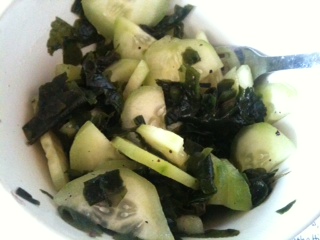
First of all, get your rice on to cook (instructions for perfect short-grain rice are here) and toast up some sesame seeds. Also immerse some wakame seaweed in cold water to rehydrate.
Now mix 4 eggs, 4 tsp sugar, 2 tsp sake, 4 tsp corn flour and a large pinch of salt together in a bowl with a fork. Heat up a small frying pan over a low heat and wipe it with oil, when it's hot pour in a small amount of the egg mixture - about a quarter. Keep these omelettes fairly thin.
When the egg has set, flip the omelette over and cook for a minute on the other side before turning out onto a plate. Repeat until you have at least 4 omelettes, but you'll probably get 5 which means one to eat hot right out of the pan!
When your rice is done, turn it out into a glass bowl with a tbsp of rice vinegar. Fan the rice with one hand while turning and stirring it and the vinegar with a spatula in the other. The rice should go very sticky. Add the toasted sesame seeds and mix through, then leave to one side to cool down.
The salad is very easy to put together. Peel a cucumber and rub salt into the surface, massage it for a few minutes over the sink to firm up the flesh and season it. Then slice it into half moons.
Mix the cucumber with the drained seaweed and the smoked salmon, if using. Whisk up a splash of rice vinegar, a drizzle of toasted sesame oil, a pinch of sugar, black pepper and some shoyu (Japanese soy sauce) to taste.
When the seasoned sesame rice is relatively cool, place a large spoonful in the center of each omelette and fold around into a square. Lay down with the folds on the bottom and sprinkle over some furikake or pickled ginger. Serve with the salad.
 |
| QUACK! |
I salivate just thinking about this weekend treat! It is so much nicer than the takeaway version, if only because the sauce and pancakes are that much tastier, but also because you avoid the gamble of receiving burned, dry duck meat and ensure that your duck has been farmed responsibly and ethically.
Here is a good idea for using up the leftover bones and meat the following day: Thai Duck & Noodle Soup. I also use the little pancakes to go with other rich meats, such as this Spicy Beef with Wasabi Mayo dish.
It's best of all if you can marinate the duck for 24 hours before cooking, but if you don't have time (as I didn't) then it'll be fine just applied on the night. I got the ingredients for this marinade from a recipe in Ching He Huang's "Chinese Food Made Easy" but have changed the ratios.
For the marinade, mix together 2 tablespoons light soy sauce, 2 tablespoons shiao xing rice wine (or sherry), 4 tablespoons honey, 1 tablespoon of hot chilli sauce, a teaspoon of ground allspice, a teaspoon of cinnamon, a teaspoon of ground ginger, a teaspoon of salt and a crushed large clove of garlic. Stir to mix really well.
If you have time to marinade, pop him in a large (waterproof!) plastic bag with the marinade and leave in the fridge for 24 hours. Otherwise brush the marinade over the duck, really work it in, and pour the rest into the cavity and over the top.
Position the duck in a large baking tray upside down on a trivet and put in a preheated oven at 180 degrees C. Turn the duck over every half an hour, ensuring that the last half hour is with the breast side up.
Plum Sauce
I got the basics of this recipe from Jamie Oliver's "Cook with Jamie". De-stone and chop up 5 or 6 purple plums. In a saucepan, assemble a star anise, 80g caster sugar, a teaspoon of salt, a teaspoon of cinnamon, a sprinkle of hot chilli powder, a squeeze of lemon juice and lots of black pepper.
Add a small amount of water
gently dissolve the sugar over the heat. When you have a liquid bring it
up to the boil and simmer until it starts bubbling.
Add the plum peices and give it a good stir. Simmer for a further 15 minutes or so, stirring occasionally, then pour into a serving dish and leave to one side to cool down.
Chinese Pancakes
The original recipe for these came from BBC Good Food, but I adapted it and make it my way these days. This makes enough for two hungry people.
Fill a teacup with mostly plain flour, topped up with wholemeal flour. Mix this in a bowl with a teaspoon of caster sugar and 100ml of boiling water. Knead this briefly until it comes together as a dough and then leave, covered, to rest.
When you're almost ready to eat (usually while the duck is resting out of the oven), break the dough up into eight small balls. Flour the worksurface and splat the first ball with the palm of your hand, then a second one. Coat the upper surface of the first splat with sesame oil then put the second splat on top. Use a rolling pin to flatten both of them and lay over the edge of a bowl while you repeat the process with the other balls.
Heat up a dry frying pan until it's really hot and lay the first pancake in. Be really careful not to overcook these, you want them to be soft and flexible not hard and crispy. Flip the pancake as soon as it has mostly puffed up and only cook the other side for 20 or 30 seconds. Take it out and on a clean plate find the seam where the two peices were rolled together and unpick them - be careful of the steam inside - to make two pancakes. Keep under a moistened teatowel until ready to serve.
This recipe is a real gem from the Abel & Cole cookbook. It can be on the table in under an hour and has a wonderfully moist, dense, almost cakey texture. It's very filling and, at least in my mind, contains two of your five a day!
First of all grate a squash of any kind, honestly I'm not even sure what kind of squashes I used, I think any barring the squat pumpkins you get at hallowe'en would be fine (the carving pumpkins are watery and fibrous, not really good eating).
I did enough to fill a teacup to overflowing, even with the gratings pressed down hard, which is probably about the same as the mugful suggested in the recipe.
Preheat the oven to 190 degrees C.
In a large mixing bowl add the squash to a cup and a half of self-raising flour, a large pinch of salt, about half a cup of grated parmesan, lots of black olives (halved), a generous tablespoon of dried rosemary and lots of ground black pepper.
Using the (now empty) teacup, whisk up 2 eggs and a tablespoon of milk with a fork, then tip this into the dry mixture above. Mix with your hands until you have a sticky ball of dough.
Line a small baking tray with greaseproof paper and wipe with oil, then drop the sticky dough ball on top. Grate over some extra parmesan and sprinkle with flour. Bung in the oven for 45 minutes.
Leave it to rest for 10 minutes before you eat it; we had it for dinner with prociutto and a tomato and basil salad.
I ripped this recipe out of some food magazine ages ago; it was on an advert for Cauldron (the tofu brand) and had been stuffed between the pages of my Malaysian cookery book. I omitted their dessicated coconut but was otherwise reasonably true to the recipe: it was really tasty.
First of all assemble the "paste" ingredients: a couple of sliced lemongrass stalks, 2 chopped red chillies, a generous tablespoon of chopped ginger, a heaped teaspoon of turmeric, one of palm sugar and a pinch of salt. Also once sliced purple onion and a few cloves of garlic.
Heat up a pan with some oil and cook the garlic and onion until translucent, then add all of the other ingredients which you've already prepared. Cook for a minute or two before adding a can of coconut milk, 125ml water, 1 tsp tamarind paste (or more if, like me, you love the stuff), 4 star anise and a cinnamon stick. I also added a load of halved chestnut mushrooms and trimmed green beans.
Simmer on a low heat while you cook the rice. Then, while the rice is on the side having its final steam, pop the tofu in to cook through. I used plain tofu and I think it would have been even better if I'd drained it and fried it first, but it was still lovely au naturel. Serve over the rice and top with fresh coriander.
This is a great use of leftover roast pork but you could easily use a fresh cut if you wanted, just pre-cook it in a frying pan. The inspiration for this came from Rick Stein's Eastern Odyssey.
First get together, in a large saucepan, heaped tablespoons of dried shrimp, palm sugar, chopped ginger, a load of garlic and one star anise.
Add a pint of hot vegetable or chicken stock and bring up to a boil. Lower the heat and simmer gently while you pre-cook the noodles and prepare the vegetables.
Boil the kettle and get your chosen noodles on to cook; I used standard flat noodles that you can pick up at Asian supermarkets and some mainstream ones. When they are cooked, drain them and run cold water over them to stop them overcooking. Portion them out into the bottom of a deep bowl or bowls.
Slice up your vegetables, use whatever you have to hand. I had the following knocking about which were perfect for this: a red pepper, a chinese cabbage, a carrot and some chestnut mushrooms. You can also chop your leftover pork into strips at this point.
Season the soup mixture with light and dark soy sauce and nam pla (fish sauce), then drop the vegetables in to cook, along with the pork to heat through. When they are cooked to your liking, add a finely diced red chilli, sliced spring onion and some chopped coriander. Ladle into the bowls, on top of the noodles, and enjoy.