This ham is now a christmas tradition for our family (and some of our friends), enough so that I received complaints last year when I made a 4.5kg one - it was too small! This is a straightforward gift from Nigella and honestly it is worth every moment of time and scrap of effort involved in making it.
First, get hold of a cured, smoked gammon on the bone. You may need to phone your butcher a few days in advance if, like mine, they smoke their meats on premises. If you don't have a butcher, you could see if there's a stockist like mine near you, use their online delivery service (choose "gammon - smoked and bone in") or have a look around the internet for an ethical stockist in your area.
 6.5kgs is basically a massive pig leg and will feed 10 greedy people a gigantic meal. If you aren't serving it as a main meal, but as a pick and nibble treat for sandwiches, ham-egg-n-chips and general snaffling, it will last you and your guests for a good week. You can make a smaller one though, just adjust the amounts of the other ingredients.
We had a bit of a problem finding a pot big enough for ours. In fact, this is an issue we usually have every year but yet never get around to buying a big enough pot in advance. I got my husband to deploy a hacksaw to remove a peice of it (ready to make a tasty soup after xmas), so that the ham would fit into the biggest vessel we have - one of those ceramic slow-cookers.
The ham goes into the pot with a large (250ml) glass of red wine, a large quartered onion, a quartered fennel bulb, a couple of fat cloves of garlic, a couple of star anise and a tablespoon each of coriander seed, fennel seed and peppercorns. Top it up with water as far as you can and then turn the heat on and leave for at least 3.5 hours (if on the stove) or about 5 hours in a slow cooker on high - especially if the lid doesn't fit tight! Keep checking on it, top up with more water if needed and turn it over halfway through cooking.
When ready, fish the ham out and pop it in a big baking tray. Cut the outer skin off and use a knife to lightly score criss-cross diamond shapes. Stick a clove in at every X.
Heat up a saucepan containing 4 tablespoons of redcurrant jelly, a teaspoon of smoked paprika and half a teaspoon each of ground cinnamon and red wine vinegar. Give it a good old boil for a few minutes and then use a spoon or a pastry brush to coat the ham with the glaze.
Preheat the oven to 180 degrees and bake for 15 minutes or so, until the glaze has caramalised and the corners are going black.
Leave to cool before eating or you will burn your fingers!
6.5kgs is basically a massive pig leg and will feed 10 greedy people a gigantic meal. If you aren't serving it as a main meal, but as a pick and nibble treat for sandwiches, ham-egg-n-chips and general snaffling, it will last you and your guests for a good week. You can make a smaller one though, just adjust the amounts of the other ingredients.
We had a bit of a problem finding a pot big enough for ours. In fact, this is an issue we usually have every year but yet never get around to buying a big enough pot in advance. I got my husband to deploy a hacksaw to remove a peice of it (ready to make a tasty soup after xmas), so that the ham would fit into the biggest vessel we have - one of those ceramic slow-cookers.
The ham goes into the pot with a large (250ml) glass of red wine, a large quartered onion, a quartered fennel bulb, a couple of fat cloves of garlic, a couple of star anise and a tablespoon each of coriander seed, fennel seed and peppercorns. Top it up with water as far as you can and then turn the heat on and leave for at least 3.5 hours (if on the stove) or about 5 hours in a slow cooker on high - especially if the lid doesn't fit tight! Keep checking on it, top up with more water if needed and turn it over halfway through cooking.
When ready, fish the ham out and pop it in a big baking tray. Cut the outer skin off and use a knife to lightly score criss-cross diamond shapes. Stick a clove in at every X.
Heat up a saucepan containing 4 tablespoons of redcurrant jelly, a teaspoon of smoked paprika and half a teaspoon each of ground cinnamon and red wine vinegar. Give it a good old boil for a few minutes and then use a spoon or a pastry brush to coat the ham with the glaze.
Preheat the oven to 180 degrees and bake for 15 minutes or so, until the glaze has caramalised and the corners are going black.
Leave to cool before eating or you will burn your fingers!
Mussels are a pretty good bet if you're looking for sustainable seafood, although it's worth avoiding those collected using dredging methods. The MCS have given them a range of ratings from 1-3 depending on collection method, 1 and 2 is the best place to be.
This is so incredibly easy to make, but you can make it a little harder (and much tastier) by pairing it with some Kingshill Bread!
Take both the mussels and the butter out of the fridge to come up to room temperature.
Thickly slice a white onion and smash/crush a couple of garlic cloves. Heat up a deep saucepan with some olive oil and fry the onions and garlic until soft. Add a finely chopped red chilli and slosh in a glass of white wine.
Pick through your mussels (1kg serves 2 people) giving them a sharp tap, or in my case stick a teaspoon through the opening and giving them a gentle nudge, to make absolutely sure they are safe to eat. If they don't close then they aren't safe - don't eat them.
Make sure the wine mixture is bubblingly hot, keep the flame up high, put the mussels into the saucepan quickly and clamp the lid down.
While they are cooking, slice up some bread and apply outrageous amounts of butter.
Keep an eye on the mussels, it should only take about 8 minutes to cook them but what you are looking for is all the shells to be open. Any that don't open should be thrown away as carriers of instant stomach death.
Spoon out the mussels between two bowls, spooning the oniony, winey sauce over the top. Eat with your fingers and don't spare the butter.
If you can get hold of fresh wild mushrooms from somewhere, like Borough Market, during autumn and early winter then definitely make the most of it. Otherwise, a lot of shops sell them dried in little tubs or packets, which can be reconstituted in water prior to cooking.
All risottos start with the same basic essentials, or at least mine do: a diced onion and a couple of diced celery stalks, sauteed in butter and oil until soft.
Add 300g of risotto rice and stir it through, letting it get hot. From experience, it is worth forking out for the pricey arborio stuff, it cooks in half the time of the other, cheaper, short grain varieties I tried using. Slosh in a glass (or teacup) full of white wine and stir through the rice mixture until it's all been absorbed.
Keep 750ml of hot vegetable stock in a saucepan on the heat and pour the first ladleful into the rice. Keep the rice on a medium heat, at least enough to keep it at a low sizzle. Stir, stir, stir and stir again. Keep stirring. Even if your arm is about to drop off, keep gently stirring the rice.
Eventually the stock will be absorbed and you'll need to add another ladle of stock and do it all over again. I mean, don't beat it up or anything, but do keep stirring and adding stock and stirring.
After adding all the stock, the rice should be near cooked. At this stage I turn the heat down very low (or even off), put a lid on the pan and get on with the exciting part.
Pick over and clean your mushrooms, in this case we had a good few handfuls each of chanterelles, trompettes, girolles and ceps. Heat up a frying pan with a little oil and butter, with some crushed garlic. Saute the large mushrooms first, adding in the smaller ones after the chunky ones have had a bit of a start.
When the mushrooms are ready mix them into the hot rice mixture with tons of grated parmesan and chopped parsley.
If you can get hold of one (and I'm soooo lucky, my husband bought me one as a present!), grate in a lovely load of black truffle - also known as winter truffle.
Finish with some butter and freshly cracked pepper and some truffle shavings.
This is properly entitled "big fat roast dinner for lazy, lardy layabouts". At the very least the trimmings deserve more of a mention: rosemary and pancetta wrapped pheasant with roast chestnuts, curly kale and roast potato cubes. That was a bit too long for the title though!
It sounds a bit complicated and lengthy to make but it really isn't, it didn't even take a full hour.
First of all take some pheasant breasts (1-2 per person depending on appetite; I had one, my husband had two) and pat clean with some kitchen roll. Lay a small sprig of rosemary on top of each one and wrap it in a couple of slices of pancetta. Place in a small roasting tray with some oil and a sprinkle of salt and pepper. Cover with foil and leave to one side while the oven preheats to 200 degrees C.
Boil up some small potatoes until mostly cooked but still firm in the middle. Drain and cut them into little cubes. Add to another small baking tray that has been lined with greaseproof paper. Drizzle some oil over and season with salt and pepper. If you like (and I do) sprinkle some finely chopped pancetta in as well. Mix until the potato cubes are coated with the oil.
When the oven is hot bung both trays in together and leave be for 15-20 minutes.
In the meantime you can decant your chestnuts * onto a third small baking tray and tear up your kale into a saucepan. If you find any little green caterpillars you could pop them into the garden with a complementary kale dinner of their own, as we did - that was a very narrow escape for a cabbage white butterfly-to-be. If your garden is full of brassicas though you might not - it depends on your take of these things!
After the 15-odd minute roast, remove the foil off the pheasant breasts and pop the chestnuts in on the shelf below. Cook for a further few minutes until the pancetta has crisped up.
Turn the oven off, but leave the potatoes and chestnuts in there. Put the pheasant breasts onto a warm plate and re-cover with foil, leave to rest while you sort out the gravy and briefly cook the kale, with a sparing amount of hot water, until tender.
To make the gravy just pop the roasting tray the pheasants were in onto a medium heat with a slosh of red wine, a dollop of redcurrant jelly and a small amount of cornflour. Scrape and stir and let it bubble away until it tastes good and has the right consistency.
* You can get pre-cooked and peeled chestnuts from, as far as I'm aware, abel & cole, waitrose and sainsburys. The brands I know are Organico and Gourmet Merchant.
These are a weird scanditalian fusion that I made up when I couldn't think what I was going to cook for dinner. These would work just as well with pasta as they did in a baguette. They're easy, cheap and really tasty.
You need about 250g of beef mince (half a pack) to feed two greedy adults. First finely dice a yellow onion, a couple of celery stalks and a carrot and fry them gently with a crushed clove of garlic until they are soft. Preheat the oven to 200 degrees C.
Split this mixture, removing half to a bowl and leaving the other half on the heat. Add the mince to the vegetables in the bowl and season with salt, pepper and a generous sprinkle of ground allspice. Mix up by hand and form into little balls, lay these on a baking tray lined with greaseproof paper and pop in the oven for about 20-30 minutes until cooked all the way through.
Add a tin of chopped tomatoes to the vegetables still in the frying pan, a squeeze of tomato puree, a capful of vodka, salt, sugar, pepper and a finely chopped, deseeded chilli. Let it come to a bubble and then leave to simmer for 5 minutes. Stir in a generous amount of finely chopped parsley and basil.
When the meatballs are done mix them into the tomato sauce and pop the baguettes, sliced lengthwise, under a hot grill to toast up. Butter the baguettes, fill them with the saucy meatballs and enjoy - eat them with your hands, it's much more fun than cutlery.
I have a lovely neighbour who looks after my car ("Big Sil") as I am rather mechanically challenged. Last week he very kindly filled her up with coolant, checked the oil and tyres and things so I thought I'd make some cookies for him and his family.
The recipe comes from Kitchen by Nigella and worked out absolutely perfectly. Instead of a bag of chocolate chips, which I think sometimes taste a bit... funny, I just got a bar of organic cook's chocolate and cut it into chips.
First, melt 150g of butter in a pan and then set on one side to cool down. Preheat the oven to 170 degrees C.
Measure out 125g of soft brown sugar and 100g of normal caster sugar into a large mixing bowl, then pour the warm butter over the top and stir together. Add 2 teaspoons of vanilla essence followed by a chilled egg and extra yolk. Beat them together until lovely and creamy and then slowly fold in 300g of plain flour and 1/2 a teaspoon of bicarbonate of soda.
When you have a beautiful, golden, sticky dough, chop up your chocolate to make chocolate chips - about two thirds of a large bar - and stir it through.
Lay out a baking tray and line it with greaseproof paper, oil it lightly to make sure your cookies won't stick. Use an ice cream scoop to place dollops of dough on top, cook them in two batches as they spread out quite a lot when they cook. The recipe said this would make 14 cookies and that's exactly what I got.
Bake for 17 minutes and leave to cool slightly before transferring to a wire rack. They do need to be cool before you eat them for the texture to be just right.
I used to hate liver, really really hate it. I think a lot of people do. The taste and texture of overcooked liver, as often served in schools or by grandparents, is not dissimilar to that of soggy cardboard marinated in angostura bitters.
Properly cooked liver is brilliant though. Even high-welfare organic offal is cheap as chips and, cooked with care, is tender, juicy and delicious. It's also full of vitamin a, iron and vitamin c.
 There are three different kinds of (non-poultry) liver that you can commonly get hold of: pig's, lamb's and calves'. I've had all three and they all cook up a treat, simply prepared as in this recipe.
 However, a little note on buying liver... organic liver generally is fine in most cases but be cautious about where you get calves liver from. Make absolutely sure it hasn't come from veal calves whose treatment you wouldn't want to subsidise. Where possible, I'd look for liver from British raised pink or "rose" veal calves. I'll post more on this, rather touchy, subject in the future when I have time to do it justice.
 Thickly slice a couple of onions, fry them up until really nice and soft and put them to one side. Make up your gravy using some stock thickened with cornflour and enhanced with a little red wine and redcurrant jelly.
 Slice up the liver and fry for literally a minute or so on each side. Be really, really careful not to overcook it, you just want it tender and barely cooked through.
Basic colcannon is just mashed potato with cabbage in. I had leftovers from dinner the night before, so I just mashed them up, added a bit of seasoning and butter and heated them through.
The mash goes first on the plate, then the liver, onions and finally the gravy. Fabulous old-style food at its best.
Slice up the liver and fry for literally a minute or so on each side. Be really, really careful not to overcook it, you just want it tender and barely cooked through.
Basic colcannon is just mashed potato with cabbage in. I had leftovers from dinner the night before, so I just mashed them up, added a bit of seasoning and butter and heated them through.
The mash goes first on the plate, then the liver, onions and finally the gravy. Fabulous old-style food at its best.


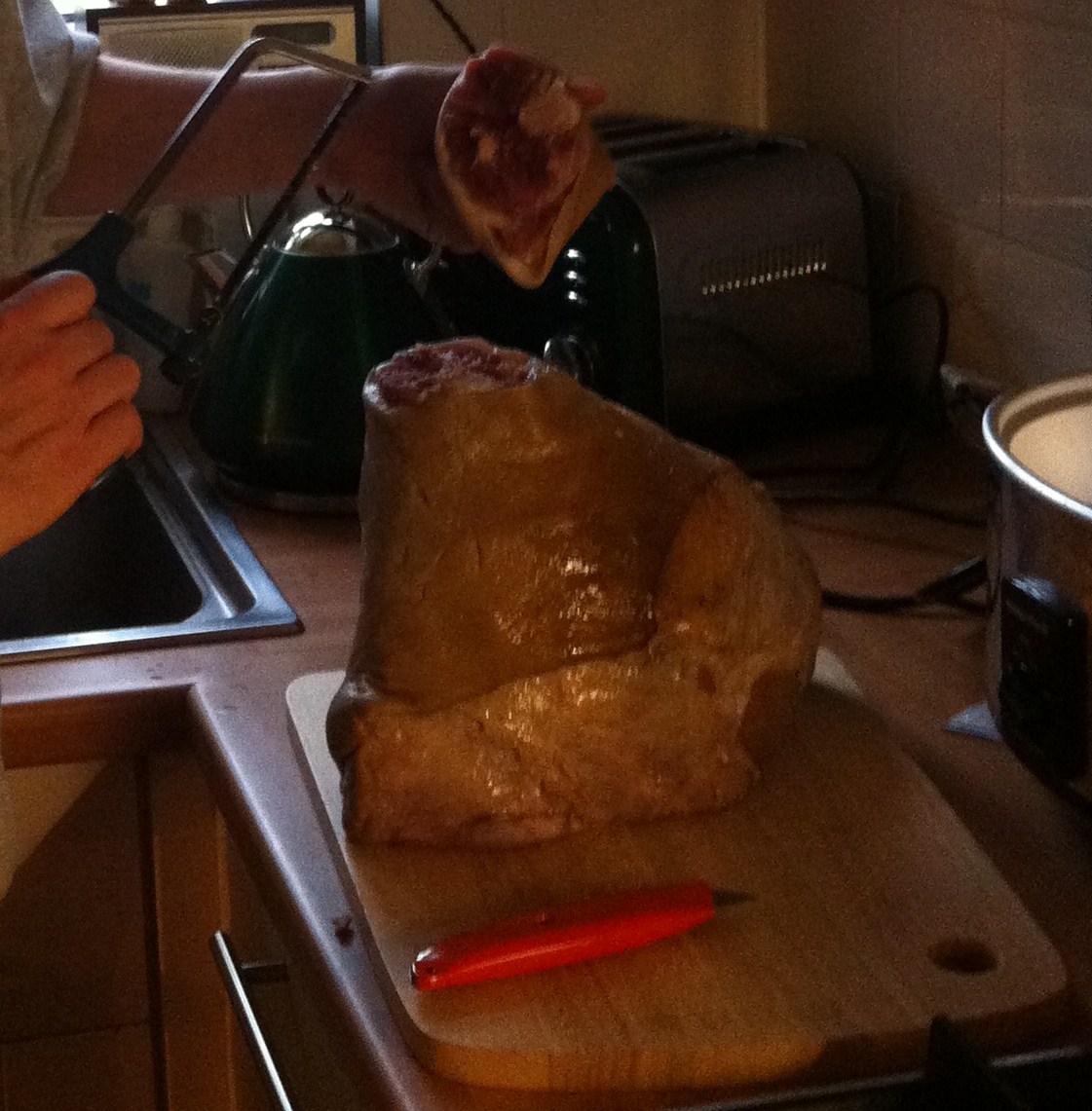 6.5kgs is basically a massive pig leg and will feed 10 greedy people a gigantic meal. If you aren't serving it as a main meal, but as a pick and nibble treat for sandwiches, ham-egg-n-chips and general snaffling, it will last you and your guests for a good week. You can make a smaller one though, just adjust the amounts of the other ingredients.


